Blog
What Is AI Share of Voice? How to Measure It
AI share of voice is the share of AI answers that name your brand across a fixed set of buying prompts, run several times on each engine. It can be read two ways: the percentage of answers that mention you, or your mentions as a share of all the brands mentioned. Either number only means something if the prompts stay the same, each one runs many times and the setup is clean.
Even that definition is still settling. GEO is a young discipline, and plenty of the people selling it don’t yet measure it with the rigor it needs.
The work starts with the prompt set. The company and its agency agree on 20, 30, 40, even 50 prompts to track, and, ideally, the list stays the same from one month to the next. That is how we work. Each prompt then runs many times, at different moments. Otherwise you are measuring noise.
The result also has to be clean. Test from an account tied to your company, or one with a history of work on your brand, and the engine already knows who you are. Whichever engine it is, it brings that context into the answer, and your brand comes out overrepresented. Location skews it too, because the engine leans toward businesses near you. So the test runs logged out, in incognito to strip the history and through a VPN to strip the location.
Done that way, you get a real appearance rate. Above all, look at the big competitors: which levers they pull and where their citations come from, because those sources change slightly from one topic to the next.
We checked these rules on October 9, 2026, with 10 buying prompts in one software category: invoicing tools for freelancers. Each prompt ran three times on ChatGPT and three times on Perplexity, and on Google AI Mode with two country settings (17 usable answers). With one ChatGPT answer logged out, that is 78 answers, all to questions written in English that never mention a country.
How do you calculate AI share of voice?
There are two common formulas, and they give very different numbers:
- Appearance rate: the answers that name the brand, divided by all answers.
- Share of mentions: the times the brand is named, divided by all brand mentions in those answers.
Here is the same set of 30 Perplexity answers, read both ways:
| Tool | Appearance rate | Share of mentions |
|---|---|---|
| Zoho Invoice | 87% (26 of 30) | 26% |
| FreshBooks | 60% (18 of 30) | 18% |
| Wave | 33% (10 of 30) | 10% |
| Harvest | 23% (7 of 30) | 7% |
| Invoice Ninja | 23% (7 of 30) | 7% |
The 30 answers contained 100 tool mentions, so each share of mentions is that tool’s count out of 100. We left out PayPal, Stripe and Wise, and pure time trackers; Square and SumUp were counted for their invoicing products.
Appearance rate tells you how often you are in the answer at all. Share of mentions tells you how crowded the answer is around you. Zoho Invoice is in almost every answer, but rarely alone: it holds about a quarter of the mentions.
The tools on the market don’t agree either. Semrush’s AI visibility metrics count a brand’s mentions against its competitors’. Ahrefs measures a share of impressions, built from search volume. Bing Webmaster Tools reports Citation Share, your site’s share of all the citations shown for a grounding query. Before you compare two numbers, check the formula, the prompts and the engines behind each one. Our GEO glossary keeps those definitions and their sources side by side.
Decide also whether you count mentions or linked citations. Here the gap was small: logged-in ChatGPT linked the vendor’s own site in 99 of the 102 times it named an invoicing tool. It is not always so. In our October 6 software test, ChatGPT linked the site of 80% of the brands it named in English but only 29% in Spanish, as we covered in how to get your SaaS cited by ChatGPT.
Why does a single run mislead?
Because the list changes from one run to the next. Asked three times on the same engine, the same morning, the same question returned exactly the same set of tools in only 1 of 10 prompts on ChatGPT, and in 1 of 10 on Perplexity. On average, about three tools per prompt came and went between runs on ChatGPT, and two on Perplexity.
Sometimes the change is at the top:
- For freelancers paid in several currencies, Perplexity’s first pick was FreeAgent (for UK freelancers) in the first run, FreshBooks in the second and Invoice Ninja in the third.
- For the easiest tool for a new freelancer, its first pick went from sevdesk, a German product, to Zoho Invoice and then to SumUp.
- On ChatGPT, “What is the best invoicing software for freelancers?” returned a Spanish shortlist twice and an international one the third time.
SparkToro saw the same at a larger scale. In its January 2026 study of 2,961 answers from ChatGPT, Claude and Google’s AI, the chance of ChatGPT or Google’s AI giving the same list of brands twice was below 1 in 100. Its conclusion matches ours: a visibility percentage across many prompts and repeated runs is a usable metric, and a single answer or a “ranking position” is not.
So report the average across runs, with its range, and never a single screenshot.
How much does a logged-in account skew the number?
In our test, it produced the biggest difference we saw, although we can’t fully separate the account from the engine. All three engines ran from the same computer in Spain, with the same English prompts:
| Tool | ChatGPT, logged in to an account with history (30 answers) | Perplexity, incognito mode (30) | Google AI Mode, personalization off (17) |
|---|---|---|---|
| Holded | 73% | 0% | 0% |
| Quipu | 53% | 0% | 0% |
| FacturaDirecta | 50% | 0% | 0% |
| Zoho Invoice | 40% | 87% | 100% |
| FreshBooks | 23% | 60% | 82% |
| Wave | 13% | 33% | 94% |
Holded, Quipu and FacturaDirecta are invoicing tools built for freelancers in Spain. On the logged-in ChatGPT account, 28 of the 30 answers named at least one of them or another Spanish tool, and 10 explicitly framed the answer for Spain. Holded became the most-named tool on that account. On Perplexity and Google AI Mode, on the same connection, none of them appeared.
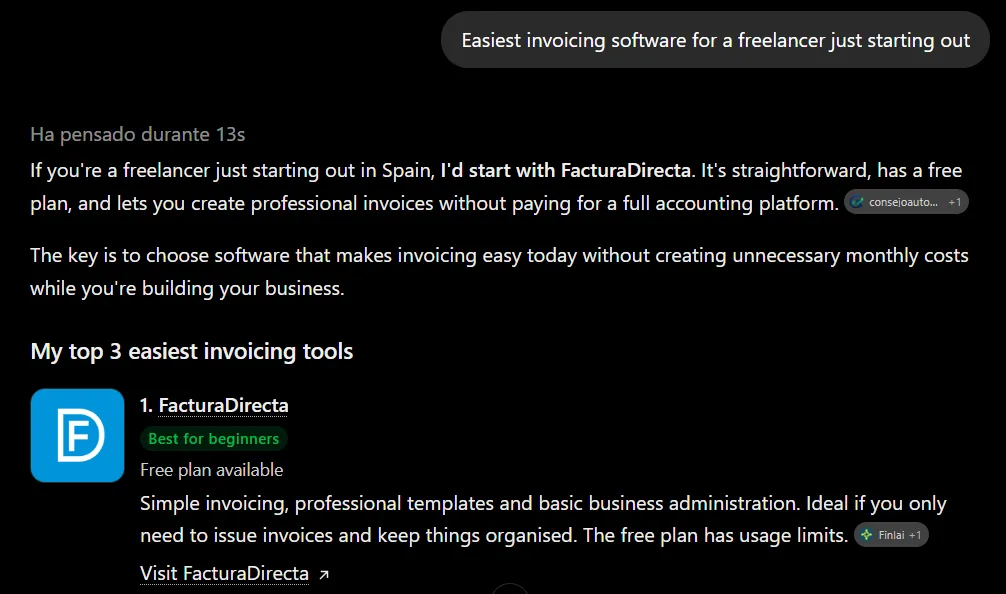
ChatGPT, logged in, October 9, 2026. The question names no country; the answer is framed for Spain from its first sentence. The interface is in Spanish because of the account’s settings.
We also got one ChatGPT answer logged out, from the same connection (the prompt went in twice, by mistake, in the same message). It opened with FreshBooks and Zoho Invoice and listed Holded third, labeled as the pick for Spain. One answer is an anecdote, not a rate: one of the 30 logged-in runs named exactly the same tools.
In practice, if a brand or its agency measures share of voice from its own logged-in accounts, the number may describe those accounts more than the market. A Spanish invoicing tool checking itself from an account like this would think it leads the category in English, while the other two engines never named it.
What should you watch besides the percentage?
Who wins each prompt, and which sources they win through. Those sources shift from one topic to the next:
- Zoho Invoice led Perplexity, in 26 of 30 answers, and its own site was among the visible sources in 25 of them.
- The writers question pulled different sources. For “What invoicing software do freelance writers use?”, Perplexity cited Reddit in two of three runs and writing sites such as The Write Life in the third. It was also the only question where logged-in ChatGPT left the Spanish tools out in two of three runs.
- Other topics, other sources. Forbes was a source in all three runs of the free-software question, and Webflow in two of the three for web developers.
- A page for another market showed up. For the cheapest-app question, Perplexity framed two of its three answers for Germany. In one of them, the first source was a vendor’s own comparison of e-invoicing software for Germany.
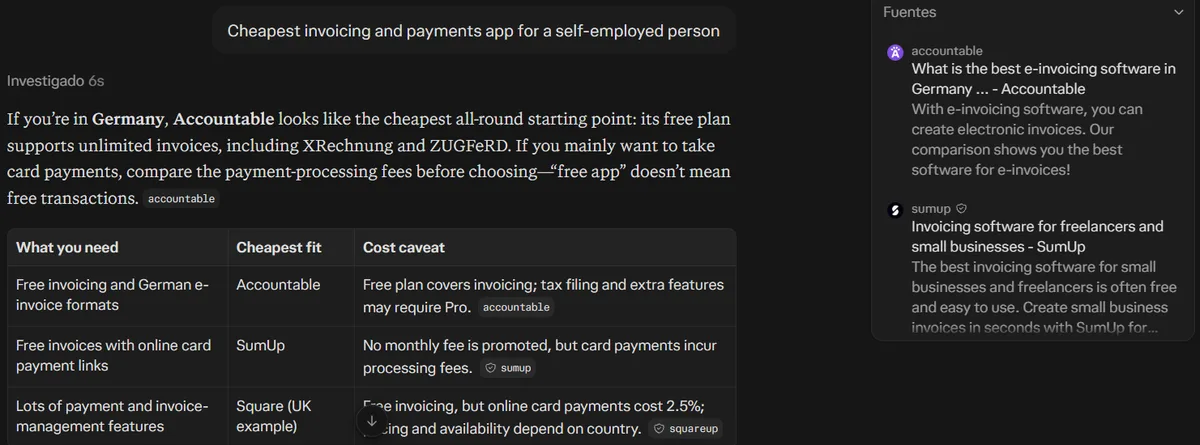
Perplexity in incognito mode, October 9, 2026. Nothing in the question points to Germany; the first source is about Germany.
Comparison and alternatives pages written for one buyer in one market end up as sources. Watch which of your competitors’ pages do, and for which questions.
What didn’t fit?
- The connection alone did not pull Spanish tools into Perplexity or Google AI Mode. We expected location to skew the results. Both ran from the same Spanish connection and named no Spanish tool, although the one logged-out ChatGPT answer still added Holded as the pick for Spain. Switching Google’s country setting from the US to Spain barely moved the leaders: Zoho Invoice, Wave and FreshBooks topped both. This was a software category; for local services, where the place is part of the question, our law firm test found maps and local rankings shaping the answers.
- Perplexity framed answers for countries we never mentioned. Germany in three answers and the UK in one. In two of the Germany answers, a vendor page for the German market was among the sources.
- Only one logged-out ChatGPT answer. A fresh browser kept hitting ChatGPT’s verification check, and in that one answer the prompt went in twice, so the logged-in versus logged-out comparison rests on one ChatGPT answer plus two other engines. We can’t say how much of the gap is the account and how much is ChatGPT itself.
- No VPN. Google AI Mode ran signed in, with personalization turned off. Perplexity ran on a Pro account with its incognito mode on.
- A small sample. 78 answers, one category, one morning. We counted tools by name. Read it as a test of the method, not as a ranking of invoicing software.
Frequently asked questions
What is AI share of voice?
AI share of voice is the share of AI answers that name your brand across a fixed set of buying prompts, run several times on each engine. It is read either as the percentage of answers that mention you or as your share of all brand mentions in those answers.
How do you calculate AI share of voice?
Run the same prompts several times on each engine. Then divide the answers that name you by all answers (appearance rate), or your mentions by all brand mentions (share of mentions). In our October 2026 test, Zoho Invoice appeared in 87% of 30 Perplexity answers but held 26% of the mentions.
How many times should you run each prompt?
More than once. In our test, three runs of the same question on the same engine returned the identical set of tools in only 1 of 10 prompts, on both ChatGPT and Perplexity. SparkToro’s study of 2,961 answers put the chance of ChatGPT or Google’s AI giving the same list twice below 1 in 100. Report the average across runs, with its range.
Should you measure AI share of voice from your own account?
No. Run it logged out or in incognito, and declare the location you are measuring. In our test, a logged-in ChatGPT account in Spain named Spanish invoicing tools in 28 of 30 answers to English prompts. Perplexity in incognito mode and Google AI Mode named none.
See who AI names in your category
Before you trust a percentage, check how it was produced. Our free AI visibility diagnosis runs real buying prompts across ChatGPT, Claude, Gemini, Perplexity and Google AI Overviews, and shows who gets named instead of you and which sources they are cited from. For tools that track this every month, see our comparison of GEO tools. For how we measure it in an engagement, see how we work.