Blog
How to Get Your Law Firm Found in ChatGPT
In my view, legal is one of the sectors where people will search through AI the most, in English and in Spanish. You don’t hire a lawyer very often, so word of mouth and personal referrals count for less than in other services. People look for references that are impartial, or that they believe are impartial, and that is the role ChatGPT, Claude and Gemini now play.
Right now it is still easy to get positioned through press articles, lawyer directories and public or media appearances. Firms need to understand that link. When someone asks an AI “who’s the go-to divorce lawyer in San Diego?”, it will recommend the firms that invested now, while it is still early. Almost anyone can still get in, but it is a game you have to start now, with a mid-term view.
That is my opinion. On October 1, 2026 we tested it.
What did we ask, and how?
Six questions, written the way a client would type them: four US cities and two Spanish ones, across divorce, personal injury, employment and estate planning. Each question went once to ChatGPT (with search), Perplexity and Gemini, all on the same morning. That is 18 answers. For each one we logged the firms named and, where the engine showed them, the sources behind the answer.
| Question | Perplexity | ChatGPT | Gemini | Named by all three |
|---|---|---|---|---|
| Who is the best divorce lawyer in San Diego? | 1 | 6 | 4 | None |
| Best personal injury lawyer in Houston | 4 | 7 | 7 | Zehl & Associates |
| I need an employment lawyer in Denver. Who would you recommend? | 3 | 5 | 4 | None |
| Top estate planning attorney in Chicago | 4 | 5 | 4 | Peck Ritchey (Kerry Peck) |
| ¿Cuál es el mejor abogado de divorcios en Madrid? | 2 | 6 | 5 | None |
| Abogado laboralista de referencia en Valencia | 4 | 6 | 5 | None |
The numbers are how many firms each engine named.
Do the AI engines agree on which lawyers to recommend?
Barely. The 18 answers named 65 different firms, and only two came up in all three engines: Zehl & Associates for personal injury in Houston and Peck Ritchey for estate planning in Chicago. In four of the six questions, not one firm appeared in all three. For the San Diego divorce question, Perplexity and ChatGPT did not name a single firm in common.
That is what “still early” looks like in the data. There is no settled answer yet, so there is room to become one.
What do they read before naming a firm?
Mostly directories, rankings and press. Perplexity lists its sources, and for two of the four US questions (San Diego divorce and Chicago estate planning) not one of them was a law firm’s website. They were directories, rankings and review sites such as Expertise.com, Super Lawyers, Avvo, Justia, FindLaw, Best Lawyers, Yelp and Forbes.
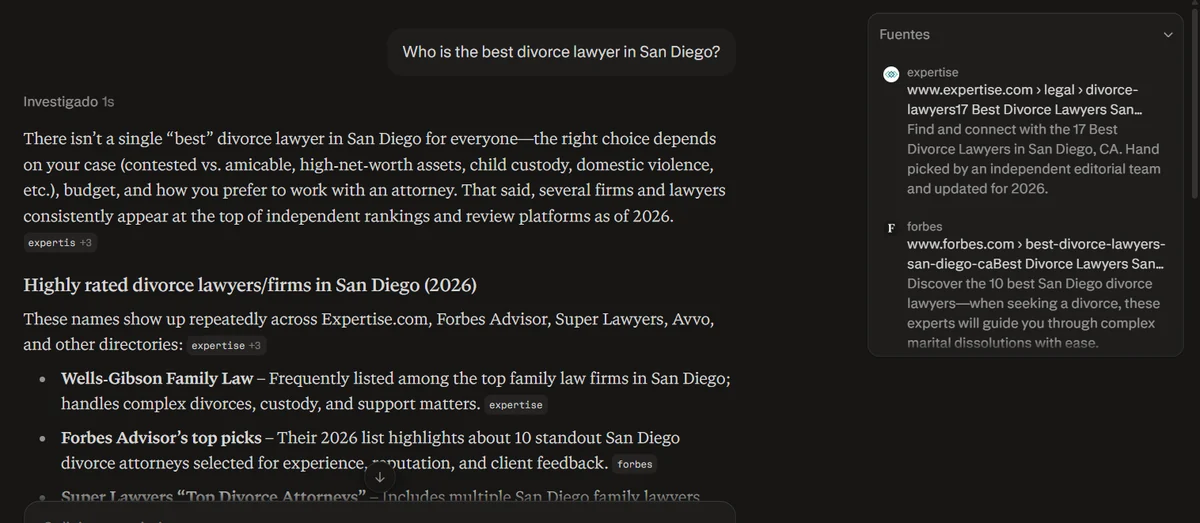
Perplexity, October 1, 2026: “These names show up repeatedly across Expertise.com, Forbes Advisor, Super Lawyers, Avvo, and other directories.” The interface is in Spanish because of the account we tested with.
ChatGPT built its San Diego answer on Doyle’s Guide, a peer-reviewed legal ranking, and its Chicago answer on Best Law Firms and Super Lawyers.
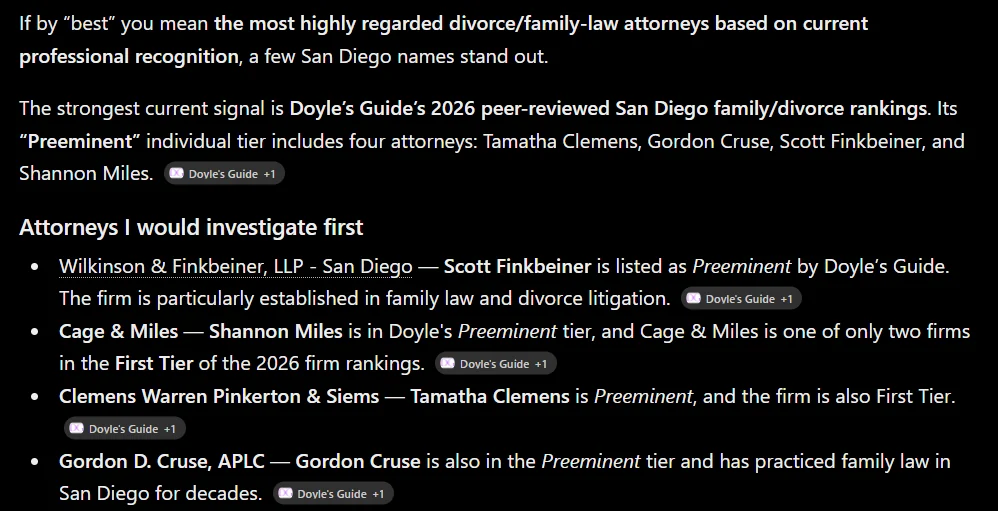
ChatGPT, same question, same morning: “The strongest current signal is Doyle’s Guide’s 2026 peer-reviewed San Diego family/divorce rankings.”
Two more details back up the press and public-role side. In Houston, one of Perplexity’s sources was a press release on Business Wire. In Denver, it cited the Colorado and Denver bar associations. And in Madrid, Gemini recommended one firm on the grounds that, in its words, the lead partner chairs the family law section of the Madrid Bar Association: a public role, not a web page.
What didn’t fit?
Two things, and a firm should know both.
The firm’s own website still gets cited in crowded practice areas. Firm websites made up most of Perplexity’s sources for Houston personal injury and about half for Denver employment. ChatGPT quoted one Denver firm’s own line that it represents employees exclusively. A page that says plainly who you represent is quotable.
Google Maps is where two of the engines start. ChatGPT opened every answer with a map of firms and their Google ratings, and used review counts as evidence (“5.0/5 from ~1,370 reviews”). Gemini did the same in all four US questions, and even listed a firm with 3.0 stars. Being on Google Maps in the right category mattered more than the score.
Spain is earlier still. In the Spanish questions, the rankings the engines leaned on were thin local sites (ranking.madrid, losmejoresdemadrid.com, abogadosconecta.es, legalrank.es) rather than anything like Avvo or Super Lawyers. In Valencia the three engines named 14 different employment lawyers and only one, Ronda Valencia Abogados Laboralistas, came up twice.
Limits of this test: one run per question and engine, on logged-in accounts, so answers can change between runs and between users. ChatGPT’s first reply to the Houston question named nobody (“I’ll compare Houston personal-injury firms…”) and only answered after a follow-up. Read it as a snapshot of one morning, not a ranking.
What should a law firm do now?
Be present and consistent in the places AI engines read before they name a lawyer:
- Directories and rankings. Claim and complete Super Lawyers, Avvo, Justia, FindLaw, Best Lawyers and Expertise, and in Spain the local ranking sites that showed up. Same firm name, address, practice areas and jurisdictions everywhere.
- Peer rankings and press. Doyle’s Guide, Best Law Firms and local business press were cited directly. One wire press release was enough to become a source in Houston.
- Public roles. Bar sections, talks, media comments. In Madrid, a bar role was the reason given for a recommendation.
- A website that can be quoted. One page per practice area and city, a sentence that says who you represent, and attorney bios with bar admissions that can be verified.
- Google Business Profile. Correct category, consistent details and real reviews. Two of the three engines start from the map.
Why now: Clio’s 2025 Legal Trends Report found that more than half of consumers have used or would consider using AI for a legal question, and 28% of those who used it were directed to contact a lawyer. Meanwhile a paid click for “personal injury lawyer near me” costs $131.33 in the US, and “geo for law firms” has a keyword difficulty of 16 (Semrush, US database, pulled September 30, 2026). Being named in the answer skips one of the most expensive auctions in advertising, and very few firms are competing for it yet.
The playbook is not unique to legal, but the sources are. Compare it with what moves SaaS (review platforms and comparison pages) or ecommerce (product schema and marketplaces), and with how Perplexity picks its citations in general.
Frequently asked questions
Can ChatGPT actually refer clients to a law firm?
Yes. Clio’s 2025 Legal Trends Report found that 28% of consumers who used AI for a legal question were directed to contact a lawyer. In our test, every ChatGPT answer that named firms ended by offering to narrow the list for the user’s specific case.
Which sources do AI assistants use to recommend lawyers?
In our October 2026 test: legal directories (Super Lawyers, Avvo, Justia, FindLaw, Expertise), peer rankings (Doyle’s Guide, Best Law Firms), press (Forbes, a Business Wire release), bar associations and Google Maps reviews. In crowded practice areas, firm websites were cited too.
Do Google reviews matter for AI recommendations?
They matter as a way in. ChatGPT showed a map with Google ratings in every answer and used review counts as evidence, and Gemini showed Google Maps listings in all four US answers. But Gemini also listed a 3.0-star firm, so being in the right category counts more than a perfect score.
How long does it take for a law firm to show up in AI answers?
Directory and profile fixes are the fastest lever, because engines re-check those sources often. First citations usually take 60 to 90 days, and competitive practice areas take longer. Measure monthly with the same questions per practice area and city, the way we do in how we work.
See where your firm stands today
Before changing anything, find out what the engines say when someone asks for a lawyer in your practice areas and cities. Our free AI visibility diagnosis runs questions like these across ChatGPT, Claude, Gemini, Perplexity and Google AI Overviews, and shows which firms they name, which sources they cite, and where yours does or does not appear.