Blog
GEO for Consultants: Which Firms AI Recommends
The companies most likely to hire a consulting firm are also among the heaviest adopters of AI. Tech companies and large enterprises have rolled out Claude, ChatGPT and other assistants on enterprise plans. According to the Ramp AI Index, 55.9% of US businesses on Ramp paid for an AI product or service in September 2026, 65.7% of large businesses did, and 43.8% paid Anthropic, ahead of OpenAI at 40.6%. Ramp’s data misses free tools, so real use is likely higher.
Those are a consulting firm’s ideal clients. When one of them needs outside help, someone may well open Claude or ChatGPT and ask which firm to hire, or which firms are already doing real work with AI. Whatever comes back shapes the shortlist before anyone calls a partner.
Software buying already works this way. In G2’s The Answer Economy survey of 1,076 B2B software buyers, 51% said they start their research with an AI chatbot more often than with Google, up from 29% a year earlier, and AI chatbots are now the top influence on their shortlists. Those are software buyers, not consulting buyers. But they work at the kind of companies that hire consultants.
That’s why getting recommended by AI is now essential for a consulting firm. If the engines can’t find a reason to name you, the shortlist gets built without you.
What did Sourcelift’s test show?
In Sourcelift’s October 27, 2026 test, we asked ChatGPT, Claude, Perplexity and Google AI Mode eight questions a US buyer might type, from which firm should implement AI agents at a 2,000-employee manufacturer to who can fix revenue cycle at a regional hospital system. ChatGPT ran logged out; the other three ran on logged-in accounts, with Claude in an incognito chat. ChatGPT and Claude both used web search. Two questions hit usage limits, one each in ChatGPT and Claude, leaving 30 answers. Four things stood out.
- The AI question went to the giants. Many narrow questions went to specialists. Accenture was recommended in all eight answers to our two AI-implementation questions, and Deloitte appeared in all eight, though Claude mentioned it for the manufacturer only as a Contender in Forrester’s ranking. For the manufacturer, smaller firms came up only as a category, like Claude’s “a smaller specialist.” Some narrow questions flipped that. For a Series B software company’s go-to-market, AI Mode said “You should avoid traditional Tier-1 enterprise generalists (like MBB),” and Claude said “Probably skip the large strategy houses like McKinsey, BCG and Bain at your stage.” Asked for boutique strategy firms in Chicago, all four engines named The Keystone Group and The Cambridge Group, and all four named Huron for hospital revenue cycle. Not every narrow question, though. For change management on an ERP rollout, AI Mode said “Deloitte and Accenture are widely recognized as the industry leaders for ERP-driven workforce adoption,” and all three answers we got on private equity portfolio operations named McKinsey and Bain.
- The engines mentioned their makers’ consulting partners. ChatGPT’s shortlist for the manufacturer included Capgemini, with the note “It is also part of OpenAI’s announced Frontier Alliance.” Its default pick, Accenture, is also an OpenAI Frontier Alliances partner, but it partners with Anthropic too, and Perplexity made it its default as well. Asked which firms actually implement generative AI, Claude named OpenAI’s Deployment Company and Ode, a services venture backed by Anthropic, and added: “I’m made by Anthropic, so weigh my mention of Ode accordingly.” It also listed early Claude Partner Network members (Slalom, Tribe AI, Turing). Partner status with the AI labs is now a credential the engines repeat.
- Job-seeker rankings and self-published lists fed the answers. Google AI Mode cited Management Consulted, a site whose rankings mostly target consulting job seekers, in 5 of its 8 answers. Claude spotted the problem, though it still cited Management Consulted three times in that answer: “Most published ‘top Chicago consulting firms’ rankings are written for job seekers, so they reflect reputation and culture more than client results.” Self-published lists worked in some engines: Perplexity cited GrowthSpree’s own list and recommended GrowthSpree, and AI Mode did the same with Genesys Growth. Claude went the other way, warning that many “best GTM agency” rankings “are published by agencies that put themselves first,” and in four of its answers leaned on Forrester, Gartner and KLAS reports.
- ChatGPT picked on published proof. Asked which firms actually implement generative AI, ChatGPT said its shortlist was “based on publicly documented implementations rather than brand reputation alone,” and backed each of its six picks with a named client case, mostly from the firm’s own site and usually with numbers: IBM with Vodafone Idea (“more than 120 AI assistants”), for example, and Accenture with Air France-KLM. It also warned that “reported results are not necessarily independently verified.” Firms’ own claims got repeated too: Claude passed along The Keystone Group’s aim of “a 5x to 10x annual return on consulting spend.”
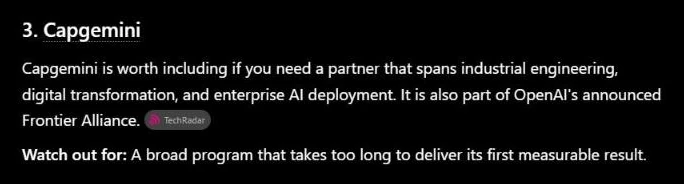
ChatGPT, October 27, 2026, logged out. Excerpt from its answer on which firm a 2,000-employee manufacturer should hire to implement AI agents.
Keep the sample size in mind: one run per question per engine, on a single day. Answers shift from one run to the next and can be personalized to the user and their location, so treat this as a snapshot, not a ranking. That’s why AI share of voice is measured across many runs.
How does a consulting firm get recommended by AI?
1. Pick the questions you can win
Generic AI-transformation questions go to Accenture, Deloitte and the other giants. Narrow questions are more open: an industry, a problem and a company size or stage, like go-to-market for a Series B software company or revenue cycle for a regional hospital system. That’s where the engines most often named specialists. List the questions your best clients would type, and work on those.
2. Publish case studies with numbers on your own site
Problem, what you did, the result and how long it took, in plain text on a page, not in a PDF or a gated deck. Anonymize the client if you need to. ChatGPT built its implementation shortlist on pages like these, and said so. Specific thought leadership counts too: for the manufacturer, it cited a Deloitte blog post on agentic AI in manufacturing. This is what citable content means for a consultancy.
3. Say exactly who you serve
Revenue band, industries, company stage and the problems you take on, stated on your homepage and service pages. The engines repeat it. ChatGPT passed along Halverson Reed’s stated target of clients with roughly $10 million to $500 million in revenue, and Claude described Winning by Design as “positioned for Series B and later companies.” Use the same description everywhere you’re listed, so the engines see one consistent firm.
4. Get into the independent sources each engine reads
Where your category has analyst coverage, it counts: Claude leaned on Forrester, Gartner and KLAS. Consulting rankings (Consulting.us, Consultancy.org), Clutch and Management Consulted showed up as sources too. Check which third-party sources come up for your questions before you spend money. As with law firms and accountants, they change by industry and by engine.
5. If you publish a buyer’s guide, show your criteria
A guide to the firms in your niche can get cited, as some publishers’ own lists were in Perplexity and AI Mode. But Claude called out, by name, lists that rank their own publisher. Show how you judged the firms and include the ones buyers really compare you with. Write it for a skeptical buyer, because that’s how Claude reads sources.
6. If you implement AI, make it verifiable
Claude judged each firm that claims to implement AI by “whether it has forward-deployed engineers (FDEs),” and warned that “headlines like Deloitte rolling Claude out to 470,000 employees describe the firm’s own internal tool use, not client implementation.” Partner programs with OpenAI, Anthropic, AWS or Google Cloud get repeated in the answers; Accenture plans to train about 30,000 people on Claude through its Accenture Anthropic Business Group. But also name your engineers and the client systems you run in production.
7. Complete your Google Business Profile
This one matters for local searches. For Chicago, Google AI Mode showed map cards for four of the five firms it named, two of them with just four reviews. Pick the right category, keep your name, address and phone number consistent with your website, and ask clients for reviews.
Frequently asked questions
What is GEO for consulting firms?
It’s the work of getting ChatGPT, Claude, Perplexity, Gemini and Google’s AI search to name your firm when a buyer asks who to hire. For consultancies that means case studies with numbers on your own site, a clear statement of who you serve, and a presence in the sources each engine reads.
Which consulting firms do AI engines recommend?
It depends on the question. In Sourcelift’s October 27, 2026 test, Accenture was recommended in all eight answers to two AI-implementation questions, and Deloitte appeared in all eight. On several narrow questions the engines moved to specialists: all four named Huron for hospital revenue cycle, and The Keystone Group and The Cambridge Group when asked for boutique strategy firms in Chicago.
Do AI engines favor their makers’ consulting partners?
One run per question can’t prove that. What it did show is that partnerships come up in the answers. ChatGPT noted that Capgemini is part of OpenAI’s Frontier Alliance, and Claude named Ode, a services venture backed by Anthropic, while telling the user to weigh that mention accordingly.
How can a boutique consulting firm get recommended by ChatGPT or Claude?
Compete on narrow questions, not generic AI transformation. Publish case studies with numbers, state exactly who you serve, get into the rankings and review sites each engine reads, and complete your Google Business Profile if buyers search locally. Then check what each engine says every month.
See what the engines say about your firm
Before you change anything, find out which firms the engines name when a buyer asks for what you do. That’s what we do at Sourcelift: we get your firm into the sources each AI engine reads. Our free AI visibility diagnosis runs buying questions like these through ChatGPT, Claude, Gemini, Perplexity and Google AI Overviews, and shows you which firms they name, which sources they cite, and where you show up and where you don’t.