Blog
GEO for Accountants: How ChatGPT Picks a CPA
For an accounting or advisory firm, showing up when someone asks ChatGPT, Gemini or Claude for a recommendation matters for one reason above all: higher-value clients. Bigger accounts, more revenue, and a better effect on your own bottom line. The businesses that ask an AI to find them an accountant tend to be the more tech-forward ones, so the first question is whether your target client is already there. If they are, you need to be in the citations.
Most accounting firms still run a fairly traditional model. If your client list is full and you have no spare capacity, this is not where your focus should go. Keep the basics right: a Google Business Profile with consistent, correct details and good reviews.
But if you want more tech-savvy clients, or you are thinking a few years ahead, AI visibility is the work. Search through AI is going to accelerate fast, especially in Google’s AI Overviews, because people want accountants and advisors who are reliable and comfortable with technology. Being in those recommendations will be essential. Act before it is too late or the category fills up.
Most of the citations are not to your own website but to third-party sites. So the job is to be present on the sites each engine cites, and that differs by engine. Some, like ChatGPT, prefer primary sources. Others lean more on directories and reviews.
What did we ask, and where?
Eight questions, written the way a business owner would type them: five local ones in US cities and three about startups, where the buyer often doesn’t care where the firm is. Each went once to Perplexity, ChatGPT with search and Google AI Mode, on October 13, 2026. That is 24 answers. For each one we logged the firms named and the sources behind them.
| Question | Perplexity | ChatGPT | AI Mode | Named by all three |
|---|---|---|---|---|
| Best CPA firm for a small business in Austin, Texas | 5 | 5 | 5 | LedgerWay (Insogna) |
| I need an accountant for my startup in San Francisco. Who should I hire? | 4 | 3 | 8 | Kruze Consulting |
| Best tax accountant for freelancers in New York City | 3 | 3 | 4 | 212 Tax |
| Which accounting firm in Chicago is best for an ecommerce business? | 4 | 4 | 5 | Chicagoland CPAs |
| Best CPA in Miami for real estate investors | 5 | 4 | 4 | Levine CPA and Advisors |
| Top-rated bookkeeping and tax firm for a restaurant in Denver | 4 | 2 | 6 | None |
| Best online accounting firm for a SaaS startup | 3 | 4 | 6 | Pilot |
| Best outsourced CFO and accounting firm for a Series A startup | 4 | 4 | 5 | Burkland, Kruze Consulting, Pilot |
The numbers are how many firms each engine named.
Do the engines agree on which accounting firm to recommend?
In local questions, hardly. The five city questions produced 49 different firms, and only four were named by all three engines, one per city at most. In Denver, not one. ChatGPT’s two restaurant specialists appeared in neither of the other answers.
The startup questions were the opposite. The same few names kept coming back: Kruze Consulting was named in 7 of the 24 answers, Pilot in 6, Burkland in 5. For the Series A question, ChatGPT and Perplexity gave exactly the same four firms. Those are firms built around one type of client, and in that niche the engines have already settled on an answer. In local accounting, they have not. That gap is the opportunity.
What does each engine read before naming a firm?
Something different each time, which is why one tactic doesn’t cover all three.
ChatGPT leaned on firms’ own pages. Of the 28 sources it cited across eight answers (23 distinct sites), 25 were accounting and finance firms’ own websites, often a specific service page: ecommerce accounting in Chicago, restaurant accounting in Denver. In four answers it also showed Google listings with star ratings, and review counts in two. The only directories it cited were Expertise.com and CPAZenith.
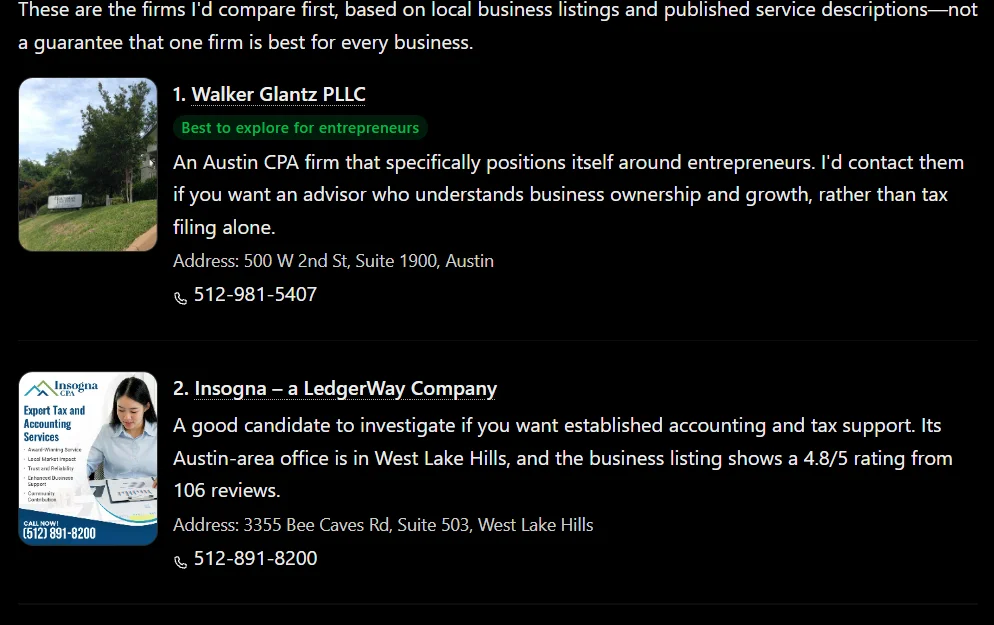
ChatGPT, October 13, 2026. “These are the firms I’d compare first, based on local business listings and published service descriptions”, then: “not a guarantee that one firm is best for every business.”
Perplexity read the open web. It cited 107 sources (91 distinct domains), and nearly half were third-party sites: Yelp (in 5 of 8 answers), Clutch, DesignRush, G2, Thumbtack, Upwork and review aggregators. Zamp, a sales-tax software company, was a source in three different cities. Its “Best Accounting Firms in Austin 2026” page was also the top Google result for the Austin question.
Google AI Mode started from Google Business Profiles. In all five local questions it showed Google Business Profile cards with stars and review counts, and in Austin it also summarized what reviewers praise. It pulled in Reddit too (in 4 of 8 answers) and, for two of the startup questions, YouTube.
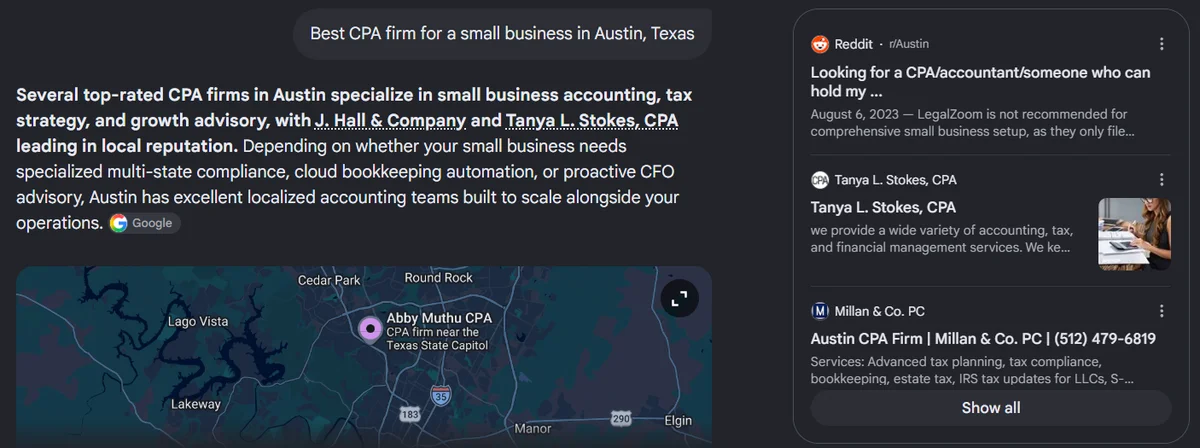
Google AI Mode, same question, same morning. The sources panel mixes a 2023 Reddit thread with firm websites.
So the second half of the opening holds: each engine has its own preferred sources. ChatGPT goes to primary sources, Perplexity mixes firm sites with directories and reviews, and AI Mode starts from Google’s own profiles and adds community threads.
Does a niche page beat a big reputation?
In this test, often. Three examples:
- Levine CPA and Advisors was the only Miami firm named by all three engines for real estate investors. It has a page titled “Real Estate CPA and Tax Services in Miami”, and 19 Google reviews. A firm with 99 reviews was named only by AI Mode.
- The Reed Corporation, a New York firm, was recommended by ChatGPT for ecommerce in Chicago and real estate in Miami, and cited as a source in two New York answers. For Miami, ChatGPT backed it on “its published Miami-focused guidance” and told the user to “confirm its current engagement options and Miami availability directly”.
- “Top-rated” did not mean top-rated. Asked for a top-rated restaurant accountant in Denver, AI Mode listed a restaurant specialist with 2.6 stars and another firm with 3.7. Specialization beat the score.
What didn’t fit?
Your own website mattered more than the opening suggests. Of the firms each engine recommended, roughly four in five also had their own website cited in that same answer: 26 of 32 in Perplexity, 22 of 29 in ChatGPT and 34 of 43 in AI Mode. Across all three engines, 122 of the 209 sources cited (58%) were firm websites, not third-party sites. Third-party sites shape who gets named, but only about one in five recommended firms made the list without its own site being cited. Where ChatGPT barely linked firm sites (one link in Austin, none in New York), it fell back on Google listings and Expertise.com.
AI Overviews didn’t show up for us. A normal Google search for the Austin question, set to the US, returned no AI Overview from our test connection. The top result was Zamp’s “Best Accounting Firms in Austin 2026”, the same site Perplexity cited. That is why we tested AI Mode, Google’s full AI search, instead.
Limits of this test: one run per question and engine, with logged-in accounts. ChatGPT personalized two startup answers to the test account’s context, even in a temporary chat, and Perplexity did the same in one Miami tip. AI Mode failed twice (“Something went wrong”) and we reran those questions once. Read it as a snapshot of one morning, not a ranking.
What should an accounting firm do now?
- Decide if it’s for you. If you’re at capacity and happy with your client mix, keep your Google Business Profile accurate and your reviews coming, and stop there.
- One page per niche and city. “Ecommerce accounting in Chicago”, “Real estate CPA in Miami”, “Restaurant bookkeeping in Denver”. Say who you serve, what’s included and what it costs. ChatGPT quotes these pages, and so do the other two.
- Google Business Profile, properly. Right primary category, consistent name, address and services, and steady reviews. AI Mode builds every local answer on it, and ChatGPT uses the ratings as evidence.
- Get into the lists the engines already read. Yelp, Clutch, DesignRush, Expertise.com and the “best accounting firms in [city]” pages that come up for your city. Check which ones each engine cites for your questions before chasing any of them.
- Show up where owners ask each other. City subreddits and founder communities appeared as sources. Real answers to real questions, not promotion.
- Measure by engine. The same questions, every month, in each engine. An average across engines hides the fact that they barely agree. We explain how in AI share of voice.
Why now: in BrightLocal’s 2026 Local Consumer Review Survey of 1,002 US consumers, 45% had used ChatGPT or another AI tool for local business recommendations, up from 6% a year earlier. Google says AI Mode has passed 1 billion monthly active users since its global launch. And in the UK, a Censuswide survey of 500 businesses for Ravical found that seven in ten SMEs act on AI-generated financial, tax or business advice before talking to their accountant. Your clients are already asking AI. The question is whether it names you.
The pattern is close to what we saw for law firms (directories, rankings and Google Maps) and different from SaaS, where review platforms and comparison pages decide, or from lodging, where the engines sent travelers straight to the properties’ own websites. For consulting firms, where analyst reports, consulting rankings and the firms’ own websites shaped the answers, see which consulting firms AI engines recommend. For how one engine picks its sources in depth, see Perplexity SEO.
Frequently asked questions
What is GEO for accountants?
It’s the work of getting ChatGPT, Perplexity, Gemini and Google’s AI search to name and cite your accounting firm when someone asks who to hire. For accountants it rests on three things: service pages by niche and city, a complete Google Business Profile with reviews, and presence in the directories and lists each engine reads.
Which sources do AI engines use to recommend a CPA firm?
In our October 2026 test, ChatGPT mostly linked firms’ own service pages and Google listings. Perplexity cited directories and review sites (Yelp, Clutch, DesignRush, G2) alongside firm websites. Google AI Mode built local answers on Google Business Profiles and, in some answers, added Reddit threads.
Do Google reviews decide which accountant AI recommends?
Not on their own. AI Mode showed ratings in every local answer and ChatGPT used them as evidence, but the Miami firm named by all three engines had 19 reviews, and AI Mode listed a 2.6-star restaurant specialist for a “top-rated” query. Fit with the question counted more than the score.
Is AI visibility worth it for a small accounting firm?
It depends on capacity and the clients you want. If your book is full, keep your Google profile accurate and stop there. If you want more tech-savvy or higher-value clients, start now: in local accounting the engines barely agree yet, so there is room to become the answer. Our free AI visibility diagnosis shows where you stand first.
See what the engines say about your firm
Before changing anything, find out which firms the engines name when someone asks for an accountant in your city or niche. Our free AI visibility diagnosis runs questions like these across ChatGPT, Claude, Gemini, Perplexity and Google AI Overviews, and shows who gets named, which sources are cited, and where your firm does or does not appear.