Blog
How to Get Direct Bookings from AI Search
If you run a hotel, an inn, a B&B, a vacation rental or a tour company, direct bookings are the part of the business you actually own. Every stay or tour booked through an online travel agency comes with a commission attached. On one of the big vacation rental platforms, hosts on its single-fee pricing now pay 15.5% of every booking, and tour operators on the big activity marketplaces have reported commissions of 20% to 30%.
To be fair, the platforms earn part of that fee. They pay to find the guest, and they handle a lot of the customer service. The catch is that you’re exposed to every decision they make. If they change the rules overnight and 80% of your bookings run through them, you don’t get a vote. You live with the change and whatever it costs you. That’s the real reason to build a direct booking channel.
Five or ten years ago, that meant solid SEO and Google Ads. Both still matter, but search has changed, and AI now plays a real part in how people plan a trip. On October 15, 2026, Google announced more links in AI Overviews and AI Mode, plus a test that puts official websites in a section at the top of AI answers. That’s good news for independent properties. Meanwhile, fewer and fewer travelers scroll down to the regular search results the way we all did a few years ago.
Right now, one of the most promising channels you have, and one of the cheapest per guest, is getting mentioned, cited or recommended by ChatGPT and the other AI engines. Each engine has its own favorite sources, so the job is to show up in the sources each one reads. It isn’t a quick fix. It takes steady work every month, but it usually costs far less than paid ads, where you keep paying every month or every season. And the window is still open: when a traveler asks an AI where to go and where to stay, independent hotels and even small inns can still make the list.
Strong reviews on Google and on the booking sites help, but they aren’t the only thing that decides who gets recommended. In our law firm tests, star ratings didn’t set the order either, and firms rated 3.4 and 3.8 still made ChatGPT’s shortlist. Lodging works the same way. What makes an AI comfortable recommending you is a technically solid website its crawlers can read, a business that’s clearly defined, the same details everywhere you’re listed and, above all, mentions on other websites.
What did our quick test show?
On October 19, 2026, we asked ChatGPT, Perplexity and Google AI Mode eight questions a traveler might ask, from the best boutique hotel in Charleston to a pet-friendly rental in the Outer Banks. Four things stood out.
- AI sent travelers to the properties’ own websites. Across its eight answers, ChatGPT linked to official websites 19 times and to booking platforms zero times. Google AI Mode showed hotels and rental companies as Google listings, each with a Website button. And 86 of the 137 sources Perplexity cited were the lodging businesses’ own websites.
- Ask who to book with, and the answer is: book direct. For a pet-friendly rental in the Outer Banks and a beach house in Destin, all three engines pointed travelers to local property managers or owners, not the big platforms, and most of those answers called out the platforms’ service fees.
- The highest-rated place didn’t always win. In 7 of the 11 answers that named a clear top pick and showed ratings, that pick wasn’t the highest-rated property in the same answer. In Charleston, ChatGPT’s top pick was a hotel rated 4.8, ahead of three it showed at 4.9 and 5.0.
- Direct-booking perks got passed along. ChatGPT shared a Savannah inn’s code for 10% off stays booked on its own site, and AI Mode added a “Direct Booking Perks” line under every Savannah hotel it listed.
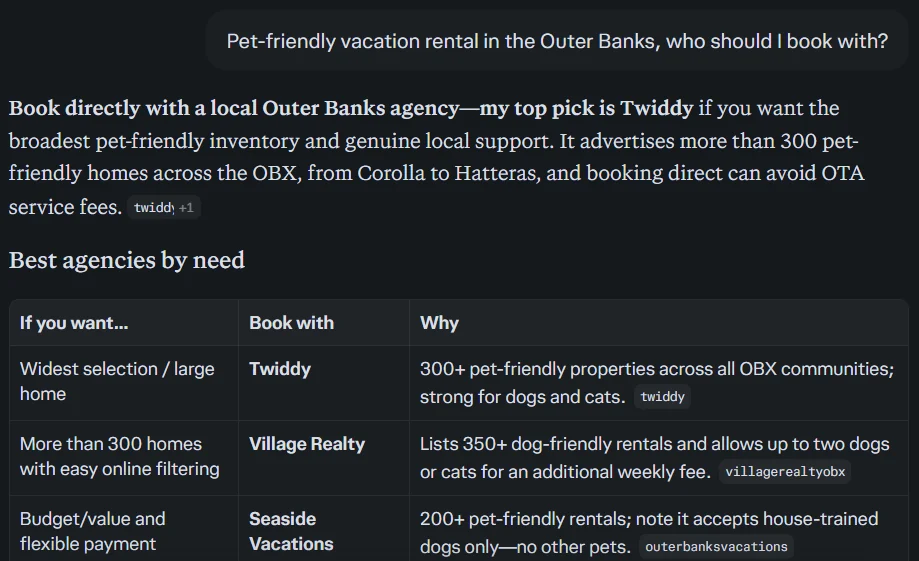
Perplexity, October 19, 2026. All five companies it named are local rental managers, each cited from its own website.
One caveat for vacation rentals. When we asked for a family cabin near the Smokies, Perplexity backed four of its five picks with listings on the big platforms. If your home only exists as a platform listing, that’s where the AI will send the guest. Keep the sample size in mind, too: one run per question per engine, on a single day. Treat it as a snapshot, not a ranking. Answers shift from one run to the next, which is why AI share of voice is measured across many runs.
How do you get AI to recommend your property?
1. Make your website the best source on your property
AI engines repeat what you publish, so put it on the page as text, not just in photos or PDFs: what makes the place different, every room or unit with its view, beds and square footage, your pet, parking and cancellation policies, and your rates or at least a price range. In our test, ChatGPT used the properties’ own pages to tell travelers which cottage or villa to request, and it quoted a rental company’s published pet policy.
2. Spell out why booking direct is better
A best-rate guarantee, a discount code, a free perk, more flexible cancellation. Whatever your reason is, put it in plain text on your homepage and your booking page. The engines passed these perks along, from a 10%-off code to free attraction tickets for guests who book direct.
3. Complete your Google Business Profile
Google’s AI answers lean on Google’s own data, and most of AI Mode’s answers in our test were built on Google listings: rating, price, hotel class and a Website button. Pick the right category (hotel, bed and breakfast, vacation home rental agency), keep your name, address and phone number consistent with your website, point the booking link to your own booking page, and reply to your reviews.
4. Give each rental a name and a page of its own
This one’s for vacation rental owners and managers. Google AI Mode actually told travelers to copy a home’s name from a platform listing and search Google for it to find the owner’s own booking site. If your home has a name and its own page on your website, that search lands on you.
5. Get mentioned in the places AI reads
Across the test, the engines cited travel media like Condé Nast Traveler and Travel + Leisure, awards lists, tourism boards like Visit Napa Valley and Explore Asheville, local guides, Reddit threads and local Facebook groups. Get listed in your destination’s official visitor directory, pitch the local guides and bloggers who cover your area, and enter the awards that matter in your category. The engines don’t all read the same places, and Perplexity’s sources only partly overlap with ChatGPT’s, so check which ones each engine actually uses for your destination before you spend money.
6. Publish useful local content
An area guide, what to know before you book a beach house, how booking direct works. Perplexity built part of its Destin answer on a local rental agency’s blog post about booking a beach house there, and one local Outer Banks guide was a source for two different engines.
7. Let AI crawlers read your site
Make sure your robots.txt doesn’t block OAI-SearchBot, PerplexityBot or Googlebot. Keep rooms, rates and policies in the page text: if they only live inside a third-party booking widget, the AI may never see them on your site. Add Hotel, BedAndBreakfast or VacationRental schema with your name, address and amenities. Our guide on how to rank in ChatGPT has the full page checklist.
8. Keep the reviews coming, but don’t chase the score
Reviews help you make the shortlist; they don’t decide the order. Collect them on Google too, not just on the platforms. For the Smokies cabin, Perplexity’s top pick came with “4.95/5 from 327 reviews,” pulled straight from a platform listing. Reviews that only exist on a platform point the AI back to the platform.
What if you sell tours or experiences?
Most of this applies to tours too, with one big difference: cancellation. On October 28, 2026, we asked ChatGPT (logged out), Perplexity (incognito mode) and Google AI Mode (signed in) seven questions a traveler might ask about tours. Three were in English, including the best Napa Valley wine tour company and whether to book a New Orleans food tour on Viator or direct, and four were in Spanish, about tours in Spain. One run per question per engine. Here’s what came back.
- Ask who to book with, and AI names local operators and links to their sites. Across its seven answers, ChatGPT linked to tour operators’ own websites 18 times and to platforms 3 times (Tripadvisor twice, Viator once). Google AI Mode never linked to GetYourGuide, Viator or Tripadvisor. For Napa, all three engines named Platypus Wine Tours, and all three listed it first.
- Ask “platform or direct?” and it comes down to price and cancellation. For New Orleans, Google AI Mode said booking direct is generally the better option and pointed out that Viator takes a 20% to 30% cut. Perplexity said to browse on Viator and book direct, unless Viator’s price or cancellation terms are clearly better. ChatGPT found two food tours priced the same on both, and said that when prices match, Viator makes sense for travelers who’d rather keep all their bookings in one place. All three brought up cancellation, and Google AI Mode and ChatGPT both noted that Viator lets travelers cancel for free up to 24 hours before the tour.
- AI looks for the company behind the listing. Perplexity and Google AI Mode both told travelers to find the operator behind a Viator listing and check its own website, and ChatGPT compared two New Orleans food tours on the operators’ sites and on Viator side by side. In our Spanish questions, Perplexity worked out which company ran a Ribera del Duero wine tour sold on GetYourGuide and pulled the price from that company’s own site. If your site doesn’t show the tour and its price, there’s nothing for the AI to compare.
- Your industry’s directory carries real weight. For a custom wine trip to Spain, the page Perplexity linked to most was Wine Routes of Spain’s list of authorized agencies, and ChatGPT used the same list as the source for two of its five picks.
If you run tours, add four things to the steps above:
- Give every tour its own page, with the details in plain text: price, length, what’s included and what isn’t, maximum group size, languages and meeting point, plus TouristTrip schema with an offer. Perplexity pulled a Rioja operator’s four tour languages straight from its website.
- Match the platforms’ cancellation policy, and say so: if travelers can cancel for free up to 24 hours ahead on Viator or GetYourGuide, offer at least that on your own site, put it next to the Book button, and give travelers a reason to book direct. Perplexity cited Secret Food Tours’ own page on why to book direct instead of through Viator.
- Get into your industry and destination directories: your trade association’s member list and your official tourism board’s listings. Perplexity cited Visit Napa Valley in its Napa answer.
- Collect reviews off the platforms, too: twice, ChatGPT’s link to book a tour went to Tripadvisor, not the operator’s own site. If your reviews only live on a platform, that’s where AI will send the traveler.
What about the big platforms’ own AI?
It’s already here. Expedia and Booking.com launched apps inside ChatGPT in October 2025, and Google AI Mode offered its own “Check availability for me” option in three of our answers. Still, in our eight everyday ChatGPT questions, neither app showed up, and ChatGPT didn’t link to a single booking platform. The window is open for independent hotels, rentals and tour operators today. Don’t count on it staying open.
Frequently asked questions
Can ChatGPT send guests to my hotel’s own website?
Yes. In our October 19, 2026 test of eight US lodging questions, ChatGPT linked to properties’ official websites 19 times and to booking platforms zero times, and it passed along one inn’s direct-booking discount code.
Do reviews decide which hotel AI recommends?
They help, but they don’t decide it. In 7 of the 11 answers where an engine named a clear top pick and showed ratings, that pick wasn’t the highest-rated property in the same answer.
Does AI recommend booking vacation rentals through the platforms or direct?
Both. For a family cabin, Perplexity backed four of its five picks with platform listings. But when the question asked who to book with, or mentioned the owner, all three engines pointed to local property managers or owner-direct sites.
How can a small hotel or vacation rental get recommended by AI?
Make your website the clearest source of information about the property, spell out your direct-booking perks in plain text, complete your Google Business Profile, earn mentions in travel media, local guides and tourism-board listings, and make sure AI crawlers can read your site. Then check what each engine says every month.
Does this work for tour operators too?
Yes. In our October 28, 2026 test of seven tour questions, ChatGPT linked to operators’ own websites 18 times and to platforms 3 times, and Google AI Mode never linked to GetYourGuide, Viator or Tripadvisor. When a tour costs the same on a platform and on your site, cancellation is often what tips it, so match the platforms’ policy and spell it out next to your Book button.
See where your property stands today
Before you change anything, find out what the engines say when a traveler asks for a place or a tour like yours. That’s what we do at Sourcelift: we get your property into the sources each AI engine reads. Our free AI visibility diagnosis runs questions like these through ChatGPT, Claude, Gemini, Perplexity and Google AI Overviews, and shows you which places they name, which sources they cite, and where you show up and where you don’t.